I. Concept and Topic Selection II. Nudity as an Ideal III. Nudity as Sin and Innocence IV. Nudity as an Object of Gaze V. Conclusion and Bibliography
I. Concept
The nude female body has appeared in European art throughout many centuries, but its meaning has constantly shifted. In antiquity, it could embody ideal beauty; in religious painting, innocence or sin; and in Renaissance and Baroque works, sensuality and desire. Furthermore, the perception of nudity depended not only on the body itself but also on the artistic traditions and cultural assumptions of the era [1, 2, 3].
I became interested in why one nude woman is perceived as a goddess, another as a sinner, and a third as an object of desire. Artists often used similar poses and gestures but created entirely different images. For instance, a hand covering the body could express modesty while simultaneously drawing attention to the nudity.
In this study, I aim to trace how artists changed the perception of the female body using poses, gestures, gazes, drapery, and surrounding objects. European paintings and sculptures from antiquity through the 18th century were selected for analysis. Special attention is paid to individual fragments of paintings that help reveal these techniques.
The research is divided into three sections: nudity as an ideal of beauty, nudity as innocence and temptation, and nudity as an object of the gaze. The works are compared not only by their date of creation but also by how artists portray the boundary between the revealed and the concealed.
My hypothesis is that the nude body in art is never perceived in isolation. Its meaning is shaped by the narrative, composition, and the heroine’s relationship with the viewer. Sometimes a completely nude woman seems unattainable, and sometimes even a clothed figure creates a sensual image.
My visual research aims to trace how the perception of the nude female body has changed.
II. Nudity as an Ideal
In ancient art, the human body was intrinsically linked to concepts of harmony and perfection. Artists sought not merely to replicate the appearance of a specific individual, but to create an idealized form. This is particularly evident in the depictions of gods and goddesses. Female nudity gradually became an independent artistic subject, with the image of Aphrodite serving as one of its primary embodiments [1].
During the Renaissance, the interest in classical models was revived. Artists once again turned to mythological narratives, portraying the human body as the embodiment of beauty [2].
However, even an idealized goddess was not always presented freely or openly. Often, she would cover her body with her hand, hair, or drapery. I find this contradiction fascinating: the gesture is meant to conceal nudity, yet it is precisely that gesture that compels the viewer to focus their attention on it.
Unknown Roman sculptor. «Aphrodite.» 1st–2nd centuries CE. Roman copy of a Greek original from the 3rd–2nd centuries BCE.
The Roman marble statue of Aphrodite relates to the ancient tradition of depicting the goddess partially covered. This style traces back to the renowned Aphrodite of Knidos, created by Prxiteles in the 4th century BCE [1, 4].
The surviving sculpture is missing its arms, but the posture of the body allows one to imagine the original composition. The goddess was intended to cover parts of her body, as if attempting to shield herself from prying eyes [4].
At first glance, her pose seems serene. Aphrodite stands, shifting her weight slightly onto one leg, which causes her hip line to tilt and her torso to form a graceful curve.
I believe this gesture cannot be interpreted merely as an attempt to hide. Even if the goddess is covering her body, she remains exposed to the viewer’s gaze. Furthermore, the movement of her arms directs attention precisely toward the parts of her figure she is trying to conceal.
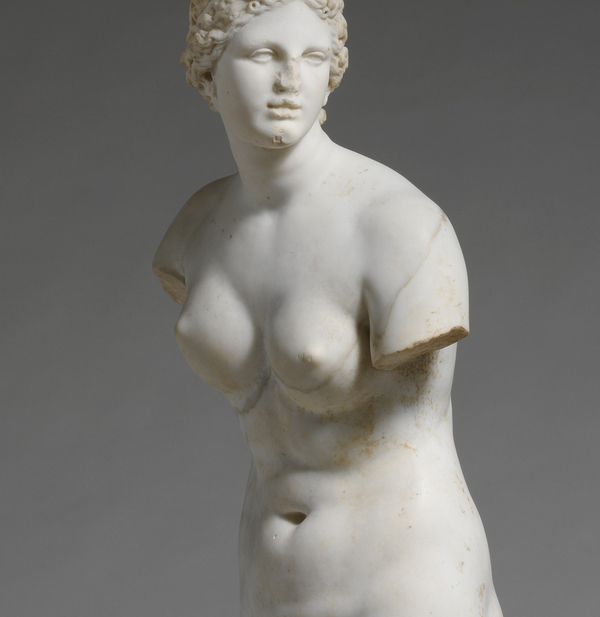
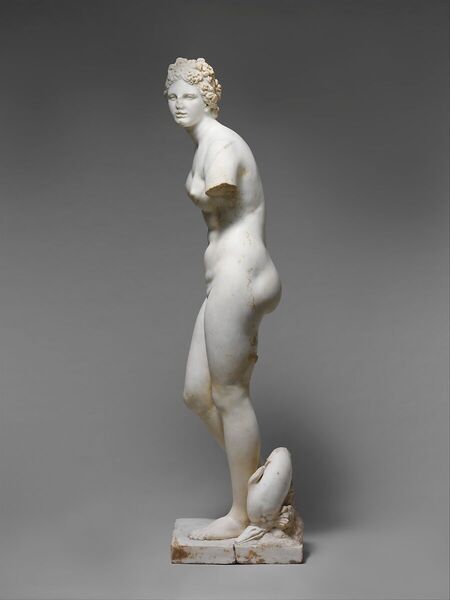
Unknown Roman sculptor. «Aphrodite.» 1st–2nd centuries CE. Roman copy of a Greek original from the 3rd–2nd centuries BCE.
If one examines the figure more closely, it is apparent that its silhouette is built on fluid lines. The curve of the waist flows into the line of the hip, and a slight turn of the torso creates a sense of natural motion.
At the same time, the body does not appear as a portrait of a specific woman, but rather as a generalized image of beauty. There are no incidental details that might distract from the figure’s harmony.
The shifting of weight makes the figure asymmetrical. One hip is positioned higher than the other, which lends the sculpture a more lifelike quality.
I believe that it is precisely the combination of the natural pose and the idealized forms that makes the image of Aphrodite special. She resembles a real person yet remains an unattainable goddess.
Thus, the nudity here is perceived as ideal beauty. Nevertheless, even without clothing, Aphrodite seems to maintain a boundary between herself and the viewer.
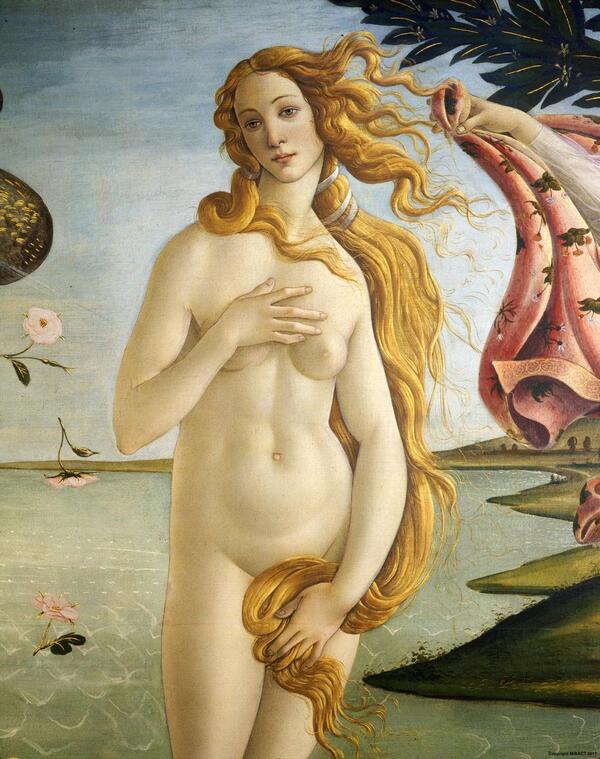
Sandro Botticelli. «The Birth of Venus.» c. 1485.
During the Renaissance, artists rediscovered classical culture and mythology. Botticelli depicts Venus emerging from the sea upon a large shell. On the left, the wind draws her toward the shore, while on the right, a female figure prepares to cover the goddess with a mantle [5].Venus becomes the focal point of the entire composition. Her figure stands out against the backdrop of the sea and sky, and the movement of the surrounding characters directs attention to her.It is particularly interesting how the artist portrays nudity. Venus covers her chest with a hand, and her lower body with long hair. Her posture references ancient depictions of the modest Aphrodite [2, 5].
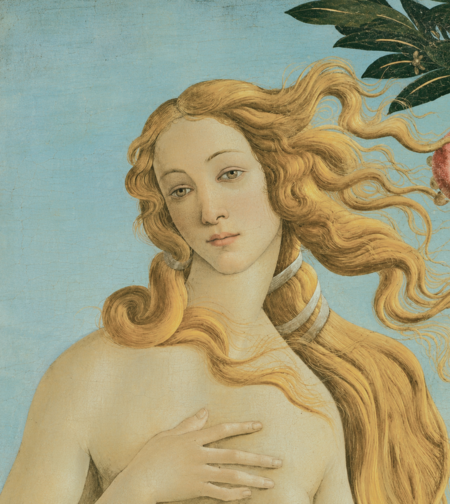
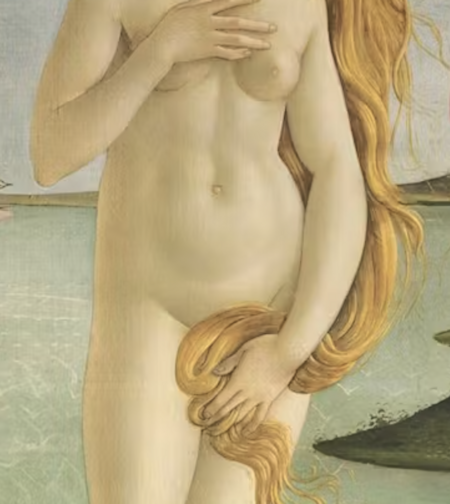
Sandro Botticelli. «The Birth of Venus.» Circa 1485.
Venus’s hair effectively functions as clothing. It conceals parts of the body while simultaneously emphasizing its silhouette. The long strands echo the curves of the figure and become an essential part of the composition.If you compare Botticelli’s Venus with the ancient Aphrodite, you can see a similar principle at play. In both works, the body is revealed, but the gesture of partial covering evokes a sense of modesty.However, Botticelli’s Venus feels less corporeal. Her proportions are slightly elongated, and her movements appear soft and fluid. I believe the artist is striving to portray not a real woman, but an almost weightless embodiment of beauty. While comparing Sandro Botticelli’s «The Birth of Venus» to the sculpture of Aphrodite, one can say that in both cases, the artists utilize female nudity as the manifestation of ideal beauty. Yet, where ancient sculpture emphasizes the volume and materiality of the body, Botticelli renders the figure more decorative.Meanwhile, the gesture of covering endures throughout many centuries. It transforms into a distinct visual sign that the viewer associates with the goddess’s image.
Ideal nudity doesn’t require complete exposure. On the contrary, the gesture of covering helps transform the body into an image of beauty that exists between openness and inaccessibility.
III. Nudity as Sin and Innocence
In Christian tradition, the nude body acquires an additional meaning. In the biblical story of Adam and Eve, nakedness is initially presented as a natural state for humankind, but after violating the prohibition, it becomes associated with shame. In European art of the Middle Ages and the Renaissance, depictions of the body often intertwined concepts of beauty with religious narratives [2].
However, nudity could be connected to more than just sin. In some works, it emphasized innocence; in others, temptation—and sometimes it served to reveal a person’s emotional state.
I am interested in how artists shift the meaning of the body while changing its degree of exposure very little. It turns out that for this, a single object, a facial expression, or a small gesture can be sufficient.
Albrecht Dürer. «Eve.» 1507.
Dürer depicted Adam and Eve as two separate, full-figure forms. In these works, the artist draws upon the ideal proportions of the human body, merging an interest in the Italian Renaissance with the detailed focus characteristic of Northern European painting [6].
Eve is portrayed against a dark background. The composition contains very few extraneous objects, so all attention is concentrated on her figure. She stands calmly, slightly turning her torso, and holds a fruit in her hand.
Her body appears idealized. The fluid lines, proportions, and posture of the figure recall depictions of ancient goddesses.
However, unlike Venus, Eve is set within a biblical narrative.
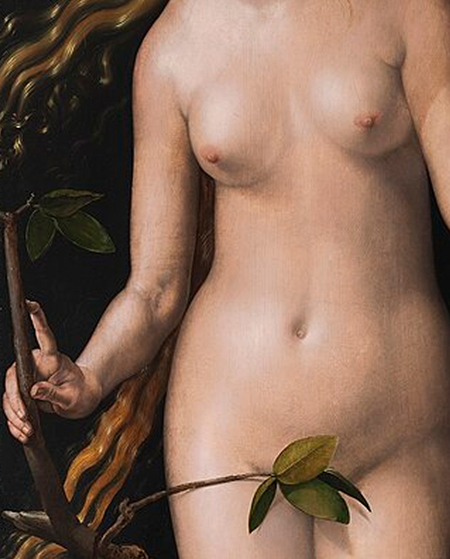
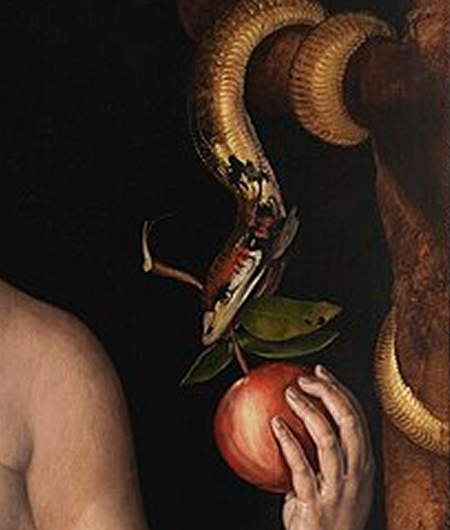
Albrecht Dürer. «Eve.» 1507.
The fruit in the heroine’s hand is particularly significant. It takes up very little space, but it alters the perception of the entire image. Without it, Eve could be perceived as an idealized female figure, akin to an ancient Venus.However, this object reminds the viewer of the prohibition and the Fall of Man.Yet, Eve does not appear guilty or frightened. Her face is serene, and her posture does not suggest a desire to hide. I believe this is the painting’s central contradiction.We see a beautiful, nude woman who has not yet experienced shame but is already connected to the story of her arrival.A comparison with Botticelli’s Venus. Both heroines are depicted nude, and their figures are constructed based on ideals of beauty. But Venus is perceived as a goddess, while Eve is presented as a participant in a biblical narrative.It turns out that the same body can evoke different associations not because of its pose or proportions, but because of the history the viewer already knows.
Rembrandt Harmenszoon van Rijn. «Warsaw with the Letter of King David.» 1654.
At the heart of the painting lies the biblical story of Bathsheba, which King David witnessed while bathing. David wished to bring her closer to himself, despite the fact that she was married. In Rembrandt’s painting, the king himself is absent; the artist depicts Bathsheba holding a letter [7].
Unlike the ancient and Renaissance depictions of Venus, the body here does not appear idealized. Rembrandt conveys natural proportions, soft forms, skin texture, and the figure’s posture.
Bathsheba is seated on fabric, having tilted her head slightly. Her pose seems calm, but her facial expression creates a sense of inner tension.
It seems to me that the main point of this painting is not the nudity itself, but the woman’s emotional state.
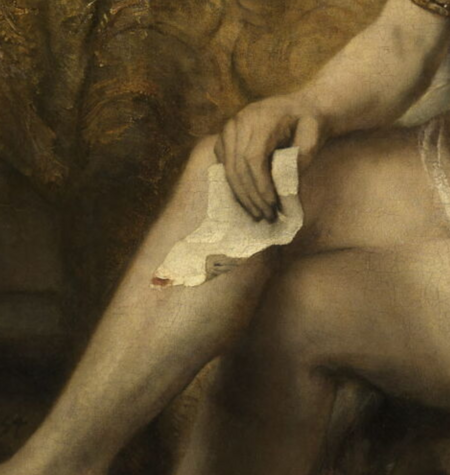
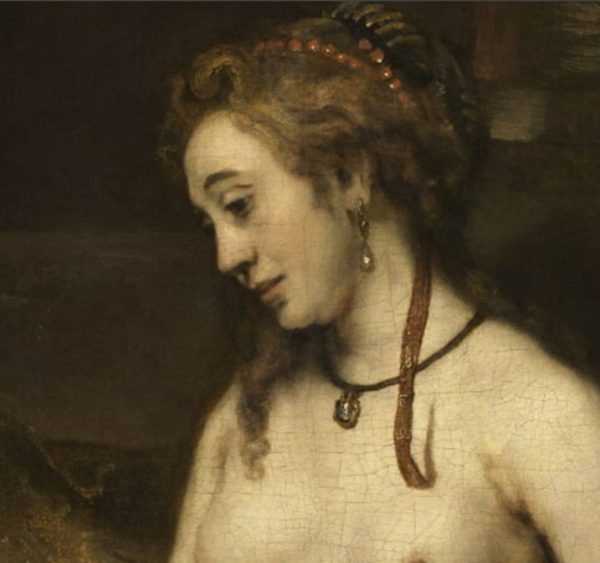
Rembrandt Harmenszoon van Rijn. «Warsaw with the Letter of King David.» 1654.
The heroine’s gaze is particularly striking. She is not looking at the viewer, seeming instead to be lost in her own thoughts. This creates the impression that we are witnessing a person in a deeply private moment.
The letter becomes the central focus of the painting. It is small, yet it is through it that the Biblical narrative is revealed.
Interestingly, Wirsawia makes almost no effort to cover her body. However, her nudity does not appear overtly provocative. On the contrary, it intensifies the sense of vulnerability.
If we compare Wirsawia to classical Aphrodite, we see contrasting approaches. Aphrodite covers her body, yet she remains an idealized object of contemplation. Wirsawia reveals nothing, yet she appears emotionally inaccessible.
It turns out that the boundary between the woman and the viewer is not created solely by clothing or gesture, but also by facial expression.
A comparison to Eve by Dürer. Eve stands before the viewer almost motionless. Her figure is idealized, and her expression conveys few strong emotions.
Wirsawia, conversely, looks very human. Her body does not strive to meet perfect proportions, and her gaze prompts reflection on her experiences.
It seems to me that a significant shift is occurring here. The nude body becomes not only an image of beauty or sin, but a means of conveying human vulnerability.
The body can be completely exposed, yet remain emotionally inaccessible. Nudity becomes an expression not only of beauty but also of human vulnerability.
IV. Nudity as an Object of Gaze
In my previous works, poses, gestures, and narrative were of great importance. However, while comparing these paintings, I noticed another significant detail—the direction of the woman’s gaze. Some heroines look directly at the viewer, others turn away, and a third seems completely unaware that they are being watched. This detail shifts the entire feeling of the piece. In European art of the Modern period, the depiction of the nude figure increasingly became a means of exploring beauty, sensuality, and the relationship between the represented person and the spectator [3]. I am curious why, sometimes, a fully nude woman feels unattainable, while at other times, even a clothed figure conveys a sense of closeness and intimacy.
Titian Vecellio. «Venus of Urbino.» 1538.
The painting by Titian depicts a nude woman reclining on a bed. She looks directly at the viewer, and her body dominates almost the entire foreground of the composition.Unlike Botticelli’s Venus, who is situated in a mythological space, Titian’s heroine is shown indoors. Two maids are visible in the background, a dog sleeps near the bed, and the woman holds roses in her hand.In the description from the Uffizi Gallery, these details are linked to love, fidelity, and marital symbolism [9].Yet, even without knowing their significance, the viewer is first drawn to the nude figure and the woman’s direct gaze.