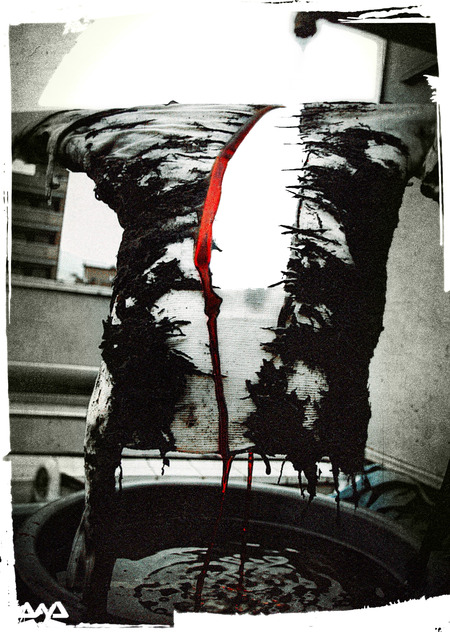
How does death, as a source of ritual defilement, become a means of purification? Kehrott Gattava compares Yukio Mishima’s novels and essays with Shinto myths to reconstruct a «dark Shintoism, ” wherein the perfect body is prepared for destruction, and the void of the imperial symbol is filled with blood.
Introduction
On November 25, 1970, in Tokyo, following a failed attempt at a coup d'état, the Japanese writer, actor, model, bodybuilder, and martial arts master Yukio Mishima committed seppuku. The story is resonant, and the question of what led Mishima to such an act has interested many. The most popular answer always pointed to narcissism and ultra-right monarchist ideals, which is obviously a severe oversimplification—though one cannot ignore that his worldview was synthesized from Shintoism and the samurai code, which is directly linked to Death. Who was Yukio Mishima paradigmically, and who was he not? He was certainly not a Buddhist, nor was he a mere nationalist. Plenty of work has been written on what later became known as the «Mishima incident, ” but I see a problem in the fact that none of the authors of these texts paid enough attention to the metaphysical and religious foundations of the worldview of Japan’s „last samurai.“ Despite the ambiguity of Shintoism, it is important to isolate the specific configuration of it that Mishima constructed for himself. The Emperor and Death as metaphysical concepts, which are directly tied to Shintoism, ultimately set the trajectories that led Mishima to the attractor in the form of ritual suicide. Thus, my task is to compare Mishima’s system of views with the ritual norms of traditional Japanese religion to find heresy—a philosophical-theological experiment consisting of examining Yukio Mishima’s position through the construction of a dark version of Shintoism (if such a thing is even possible) and providing a non-trivial perspective on the cause of what happened in November 1970 in Ichigaya.
Misanthropy
«The spirit is completely rotten.» «Everything is permeated by foolish laughter.»
The Voices of Heroic Spirits.
Examining his foundational artistic works and comparing them with his essays leads to the serious conclusion that Yukio Mishima harbored misanthropy, for which the anachronism of the imperial monarchy became the optimal mode of expression. The portrayal of the central characters is striking in his artistic works. In «The Golden Temple, ” we see a description of the main character:
«I was a frail, sickly child, the absolute last in every boys’ game and pastime. Furthermore, my innate stuttering kept me isolated from other children, fostering introversion and a love for solitude.»
Concurrently, in the essay «Sun and Steel, ” Mishima expresses a view that physical flaws are signs of spiritual deformity.
«I always believed that a stout belly (a sign of spiritual slovenliness) and a thin chest (a sign of excessive sensitivity) were extremely repulsive, so I was incredibly surprised to learn that there were people who found such physical flaws attractive. I saw bodily imperfections as something shameful—as if the owner were essentially displaying the disgraceful attributes of their spiritual ugliness.» <…> «Steel taught me to equate the physical with the spiritual. So, weak emotions began to associate with weak muscles, sentimentality—with a sagging abdomen, and excessive sensitivity—with painful, pale skin.»
Midzoguti’s subsequent actions only reinforce Misima’s negative view of his own character. He scratches the scabbard of the Katana belonging to a military cadet, curses the girl out of shame for his stutter, and is generally portrayed as arrogant, hypocritical, and malicious. The central point where Misima’s worldview converges with his character, in the form of inverse symmetry, is the burning of the shrine. The reason for the destructive act committed by the main «hero» originated at the end of the war when Midzoguti was annoyed to discover that the shrine had survived it.
«Eternity seeped from the heavens, enveloping our faces, hands, chests, burying us under its weight. Damn it! Yes—even on the day the war ended, even amidst the chirping of mountain cicadas, I heard the damned voice of eternity. It seemed to plaster me all in a thick, golden stucco.»
As a result, unable to withstand the pressure of beauty, he destroys what had become its symbol in his mind, while Yukio Mishima, conversely, chose to die for what he considered the embodiment of Japan’s cultural and national spirit. «The Golden Pavilion» places the decaying human figure—a figure of loss and the abandonment of true values and unbreakable ideals—at the center, but this is far from the only text where a person whose spirit is afflicted by the contagion of decadent modernism, against which Mishima argued, becomes the central figure instead of a positive character. «The Marquis de Sade» demonstrates the unfolding of the Marquis de Sade’s wife—a decadent woman befitting her husband. In «The Catcher in the Rye,» an analogy draws a parallel between a certain Jack, who represents a marginal dissolute, and the Marquis de Lafayette. His negative assessment of his era naturally led to the fact that Mishima’s main characters were direct representatives of the age—through whom Mishima demonstrated societal decline. Initially, his major work was supposed to be «Keko’s House,» which features five main characters, each possessing specific character traits that can be read as flaws. Collectively, they embody the trends of the post-war society, which was consumed by hedonism and egoism (or individualism). The author’s personal opinion emerges through the description of the statue of the samurai Kusunoki Masashige:
«Mountains of paper trash, an incredible number of pigeons. The pigeons were perched on the helmet between the horns. The rustle of weary travelers' footsteps, shuffling listlessly on the gravel. Overall, a depressing scene—a desolation that seemed to cover everything, like springtime dust.»
Critics tore apart the «Keko House, ” and in response, Mishima wrote the tetralogy „Sea of Plenty.“ This work essentially covers the same subject—the decline of the national spirit that began during the Taise era, the starting point of „Spring Snow, ” which became the first book of „Sea of Plenty.“ The theme of spiritual impoverishment in the tetralogy is developed through the temporal transformation of its main character, Shigekuni Honda (who periodically recedes into the background). What happens to him is directly connected to events unfolding around him between 1912 and the late 1960s. In his early youth, he loses his friend Kieaki Matsuga, whose reincarnation, according to Buddhist doctrine, becomes a fixation for Honda. Although Kieaki cannot be called a „good man”—rather, he was a frivolous egoist who went against the emperor’s decree and became involved with a young woman who was supposed to be the fiancée of a Thai prince. As a result, Kieaki dies, and the object of his sensual pleasure enters a convent. In the second volume, spiritual decay expands, engulfing both secondary characters from the first volume and new figures, such as Lieutenant Horii. He initially shows sympathy for the „purity“ ideals of the central character, Isao Iinuma of „The Cavalry Riders, ” but later betrays him at the very last moment, as well as the Japanese prince, who had shown his approval to Isao. However, once the conspiracy was exposed, the prince, out of cowardice, recoils completely from everything related to the plot. The baseness of the characters is made even more pronounced against the aspirations of Isao, who embodied the ideal of action over words. In the third volume, Honda himself begins to corrode, becoming a voyeur who falls for Kieaki’s second „reincarnation”—the Thai princess Ying-Tyang—despite being married. Alongside this, he befriends a woman named Keiko, who serves as an allusion to the „Keko House“ because she is almost identical to Keko in every way, from her decadent nature to her nihilistic hedonism. Even their life stories and names bear a resemblance. And, of course, no one would dispute that Toru Yasunaga, the central character of the fourth volume, is utterly repulsive.
The reason all of the above deserves close attention is that, in this case, the nature of the main characters says a great deal about the author’s views on humanity itself and is directly related to the position expressed in his essay.
Yukio Mishima sincerely detested the people of his era. While he is adored in far-right circles, he himself criticized both Nazis and Adolf Hitler, portraying him as a coward and traitor in his play «My Friend Hitler.» He is categorized as a monarchist-imperialist, yet he spoke favorably of the leftists while disdainfully dismissing Emperor Hirohito. The era of decline, wherever relevant in his works, is one of collapsing values. «Voices of the Heroes’ Spirits» is a continuous critique of the Emperor’s abdication of his divine status. During his famous debate with left-leaning students in 1969, he even asserted that the current Emperor belonged in the inner court—where the harem was traditionally situated.
In articles and books that examine his political views, essays are usually either disregarded or skimmed over carelessly. This conclusion is driven by the fact that almost no one has noticed his extreme radicalism. Certainly, the vast majority of articles note the importance of action for Mishima’s worldview paradigm, as well as the extremity inherent in his flamboyant nature, his far-right views, and so on, but rarely does anyone pay attention to WHAT EXACTLY Mishima understood by «action.»
In the essay «In Defense of Culture, ” he introduces a distinction between culture and culturalism. In the former, we have the authentic Japanese culture, directly connected to Death; in the latter, we have its sanitized version, stripped of anything related to radicalism or violence. Post-war Japanese „culture“ is associated with ikebana and tea ceremonies. Comparing fragments from the essay:
«Defining culturalism in a few words, one could say it is a trend of building conclusions based on certain joyful human achievements, wrenched from culture like a newborn from a mother’s womb. In this regard, culture becomes a harmlessly beautiful common heritage of humankind, like a fountain in the middle of a shopping center. <…> By synthesizing the successes of various political and social transformations, Americans concluded that the tendency to regress to the origins of culture had disappeared. That is when culturalism began. In other words, this phenomenon ceased to be harmful.»
With a fragment from «Temple at Dawn, ” which in a way explains the indifference of the aging Sigekune Honda:
«Honda only glimpsed this new world from the outside, but meeting a person who was fighting—and who had deliberately severed ties with life in a time when the spirit animating Japan’s youth was in complete isolation—he couldn’t help but tell himself: ‘Only Western energy, concepts existing outside of Japan, allows me to survive.’ Because the ideas inherent to Japan lead one to death. If you intend to live, you should not, like Isao, insist on maintaining purity. You should not cut off your path to retreat; you should not renounce everything. Isao’s death—and only his death—forced Honda to contemplate what a pure, unblemished Japan truly was. Was there another way to coexist with one’s ‘Japan’ besides renouncing everything, rejecting the real country and one’s compatriots—another way besides this most terrible one—to kill and then settle accounts with life by one’s own sword? It is frightening to say, but didn’t Isao prove with his death that there was no other way? It seems that the purest representatives of the nation were inevitably tinged with blood, marked by the stamp of barbarism. Unlike Spain, where the bullfight persisted as a national spectacle despite criticism from animal rights advocates worldwide, Japan, starting with the Meiji Restoration, wished to eradicate ‘indigenous customs.’ As a result, the newest, purest spirit of the nation went underground, and in occasional outbreaks, its cruel, terrible power manifested.»
It becomes evident that Mishima’s problem with modern culture lay in the need for humanization. «For the Defense of Culture» is far from his only text in which the attraction to destructive impulses—much like the attraction to Death—becomes the center of his position. In fact, it is his mildest expression of this stance. Mishima pushed further in his last essay from 1970, «Van Yangmin’s Doctrine as Revolutionary Philosophy, ” where Neo-Confucianism is reinterpreted as a supporting tool, a preparatory element for any revolution, one that becomes such through two components—nihilism and mysticism. Generally, considerable effort is required to transform Neo-Confucianism into an extremist system, but Mishima was never intimidated by difficulties. According to Van Yangmin, knowledge is action, and the logic proceeds as follows: revolution is action. Action is always inseparably linked to Death. Mishima calls this type of revolution „active nihilism,“ a concept expressible only through extreme radicalism. He notes with some reluctance that this kind of revolutionary fervor in the 20th century was more characteristic of the left than the right, attributing this tragic form of rebellion a „Dionysian“ character. Of course, Mishima could not escape the influence of Nietzsche. This is a wry curse of Nietzsche himself: his philosophy is readily embraced by radicals as both an extremist and an intellectual field, which likely would not have pleased Nietzsche himself, but attempts by moderate Nietzscheans to „sanitize“ his reputation to the point of a constructive system for seeking new values are never heard and are always ignored.
Regarding Mishima, his radicalization of Yan Ming is complemented by the neo-Confucian concept of returning to the Great Void through the shattering of the vessel—which is literally everything, including the human body. The void within the vessel is more significant than the vessel itself. This idea seemingly manifested in his fanatical devotion to bodybuilding. For years, Mishima transformed his body into a «beautiful vessel» to shatter it dramatically, which he did on November 25, 1970. A disdain for his contemporaries and a love for Death formed the bedrock of his worldview, which was wrapped in the veil of a return to a glorious Japan that never truly existed.
«In Defense of Culture» critiques the French president for preserving the country through defeat, masking this by safeguarding cultural heritage in the form of architecture, sculpture, and other works of art. In Mishima’s view, this approach reduces culture to mere material objects, whereas true culture is rooted in a national spirit that was completely annihilated by capitulation. To preserve culture—everyone had to kill and die. Mishima’s criticism of pacifists, Democrats, humanists, the emperor, and modern Japan boils down to one thing: all these «phenomena» are entirely «cleansed» of tragedy, Death, and violence. It was this kind of culture that Mishima considered the root of Japan, and it was this he fought to protect. In his most popular essay (at least in the Russian segment), «Sun and Steel"—written four years before his work on Van Yangmin—Mishima clearly explains what he means by the principle he will later justify through a non-Confucian interpretation of Yangmin’s thought: