I. Concept
Hand gestures can connect two figures, point to an object, signal a stop, or denote a threat. In multi-figure painting, gesture holds a dual significance: it belongs to the depicted person while simultaneously contributing to the structure of the entire scene. Through the positioning of hands, the inclination of bodies, and the distances between figures, the artist establishes connections that allow the viewer to interpret the unfolding events. Therefore, studying gesture enables an examination of how cohesive imagery emerges from individual human figures.
The source material selected for this work is Giotto’s cycle in the Scrovegni Chapel in Padua, created between 1303–1305. The scenes of this cycle exist within a unified architectural setting and are integrated into a narrative sequence. Moreover, each composition presents its own combination of characters, directions, and moments of stillness. The shared setting in time and space allows for the comparison of gestures within a single ensemble, without substituting analysis of one period with an overview of different eras.
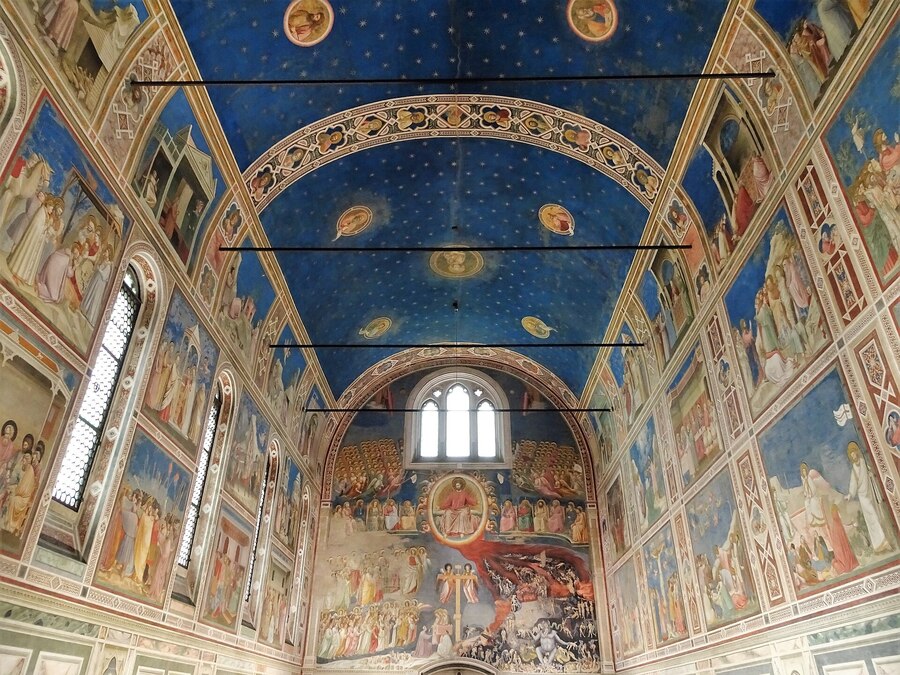
Cappella di Sкровеньи, Padua. Interior. Photograph by Derbrauni, 2017. Overall view of the interior: sequential rows of frescoes integrated into the overall architectural environment. This photograph introduces the ensemble into context.
Choosing a topic relates to the possibility of examining human interaction through visible artistic means. It is important to determine how Giotto makes the relationships between characters distinguishable: who extends a hand, who responds, who withdraws, where contact is formed, and where it remains incomplete. The relevance of this approach to visual communication lies in analyzing the distribution of attention: the direction of movement and the distance between figures help to highlight semantic connections within a complex image.
Research Question:
How do hand gestures and body postures organize the interaction among characters and direct the viewer’s attention in the frescos of the Scrovegni Chapel?
The working hypothesis is that the meaning of a gesture is determined by its inclusion in the composition. Similar movement can express closeness, submission, or confrontation, depending on the corresponding posture, the interval between bodies, and the behavior of the surrounding group. This hypothesis can be tested by comparing scenes and details.
The main building features eleven scenes: «The Meeting of Joachim and Anna at the Golden Gate, ” „The Meeting of Mary and Elizabeth, ” „The Raising of Lazarus, ” „Entry into Jerusalem, ” „The Expulsion of Joachim from the Temple, ” „Do Not Touch Me, ” „The Lamentation of Christ, ” „The Expulsion of Merchants from the Temple, ” „Judas’s Kiss, ” „The Washing of the Feet, ” and „Christ Before Caiaphas.“ „The Nativity of Christ“ is included separately to compare the maternal inclination with „The Lamentation.“ Selection is determined by the presence of clear gestural interaction and the possibility of comparing it to another example. The complete cycle is not treated as a single, exhaustive system of meaning.
The research method is comparative visual analysis. Initially, the entire composition is examined, followed by the positioning of individual figures and hands. For each scene, the direction of movement, the presence or absence of contact, the degree of reciprocity in the gesture, and its relationship to the surrounding group are recorded. Enlarged fragments are used alongside general views because an isolated detail can obscure the relationships upon which its meaning depends.
The principle of categorization is typological: chapters are organized according to the functions of gesture. The text sequentially examines touch, direction, distance, mourning, collision, and the relationship between action and stillness. These categories can overlap. For instance, an embrace simultaneously connects bodies and restricts movement, while a gesture of mourning directs attention toward the deceased body. Each chapter highlights a specific function, which is then tested by comparing artworks. This structure allows the reader to move from a local contact between two characters to the composition of a multi-figure scene.
Brief plot summaries are provided to establish the participants and the nature of the event. The observed positions of hands and bodies are separated from the interpretation of their meaning. The work does not presume that an emotion can be precisely determined from a single posture, nor does it attribute psychological states to characters that are inaccessible to observation. Statements regarding closeness, tension, and distance primarily describe the visual effect of the composition.
Textual sources were selected based on subject relevance: official chapel materials are used for context and dating, the university catalog and the Web Gallery of Art—for scene identification, and Smarthistory lectures—for correlating specific observations with art historical analysis. The findings presented are based on the provided images.
The goal of this research is to demonstrate how Giotto transforms human gesture into a means of organizing pictorial narrative through combinations of contact, direction, and pause.
II. Touch: How Gesture Connects Forms
The touch makes the connection between the characters directly visible. Hands cross the space between bodies, and the turning of heads clarifies who the movement is addressed to. It is important to distinguish the mere fact of contact from its reciprocity: one figure may reach toward another, receive support, or hold them steady. In Giotto’s scenes of encounter, one can observe how two independent figures form a unified group while maintaining the distinction in their poses and positions.
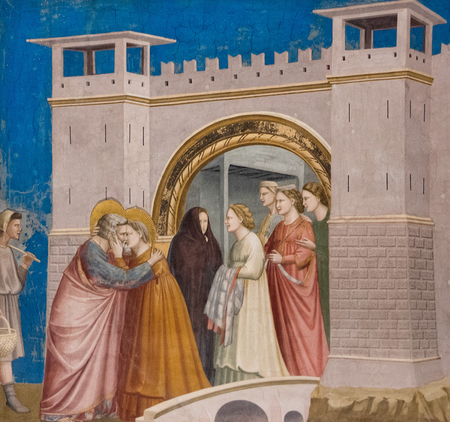
Giotto. «The Meeting of Joachim and Anna at the Golden Gate» 1303–1305. Fresco. Scrovegni Chapel, Padua.
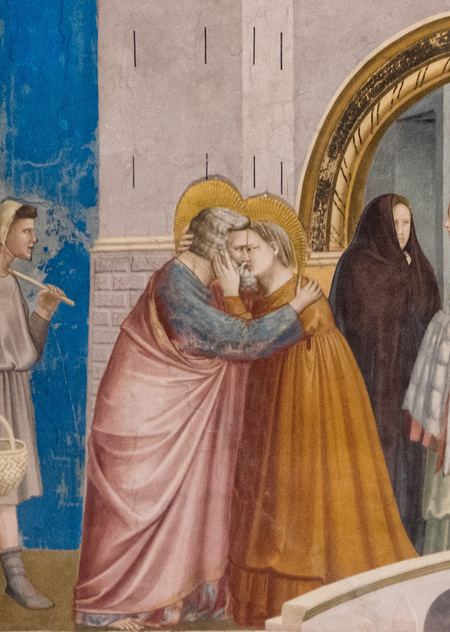
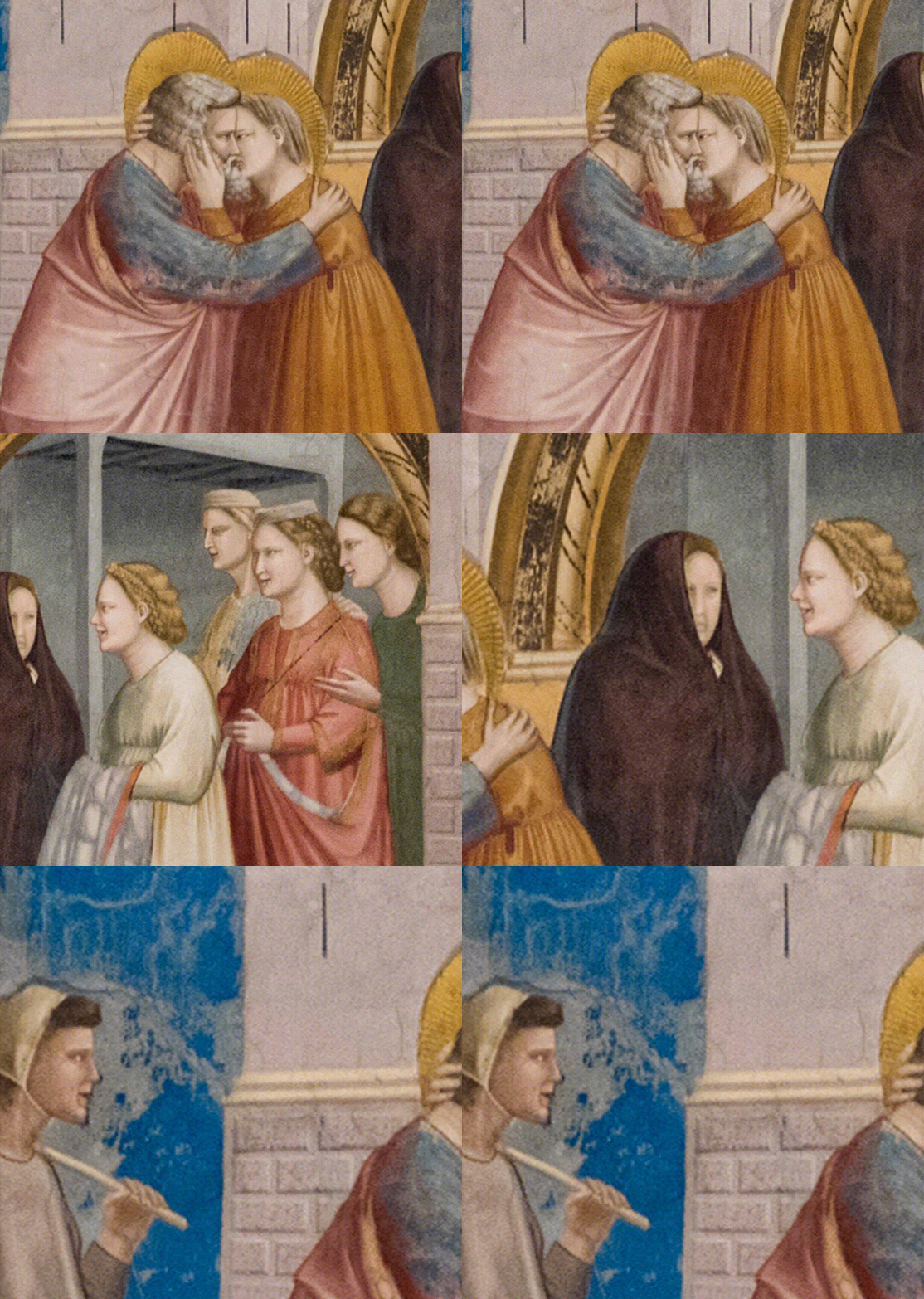
At «Meeting at the Golden Gate,» Joachim and Anna bring their faces close and embrace. The tilt of their heads continues the movement of their arms—the visual connection is not limited to one hand, but encompasses the upper portions of both bodies. The contours of the figures partially overlap, so the embrace is perceived as a gathering movement. The couple’s position relative to the onlookers is significant. Their faces are turned toward the action, but they are not included in the embrace itself. This creates two levels of involvement: direct contact and observing it. Because of this, the main episode is discernible within the larger group.
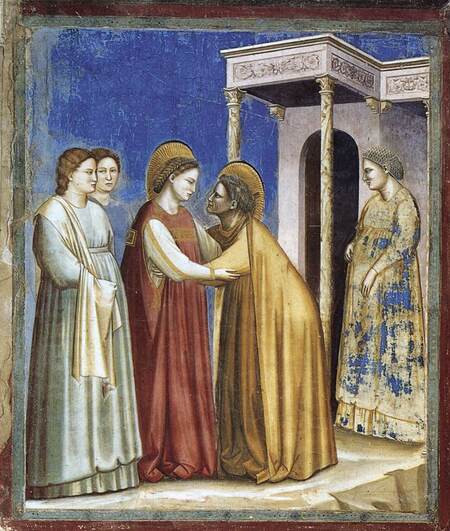
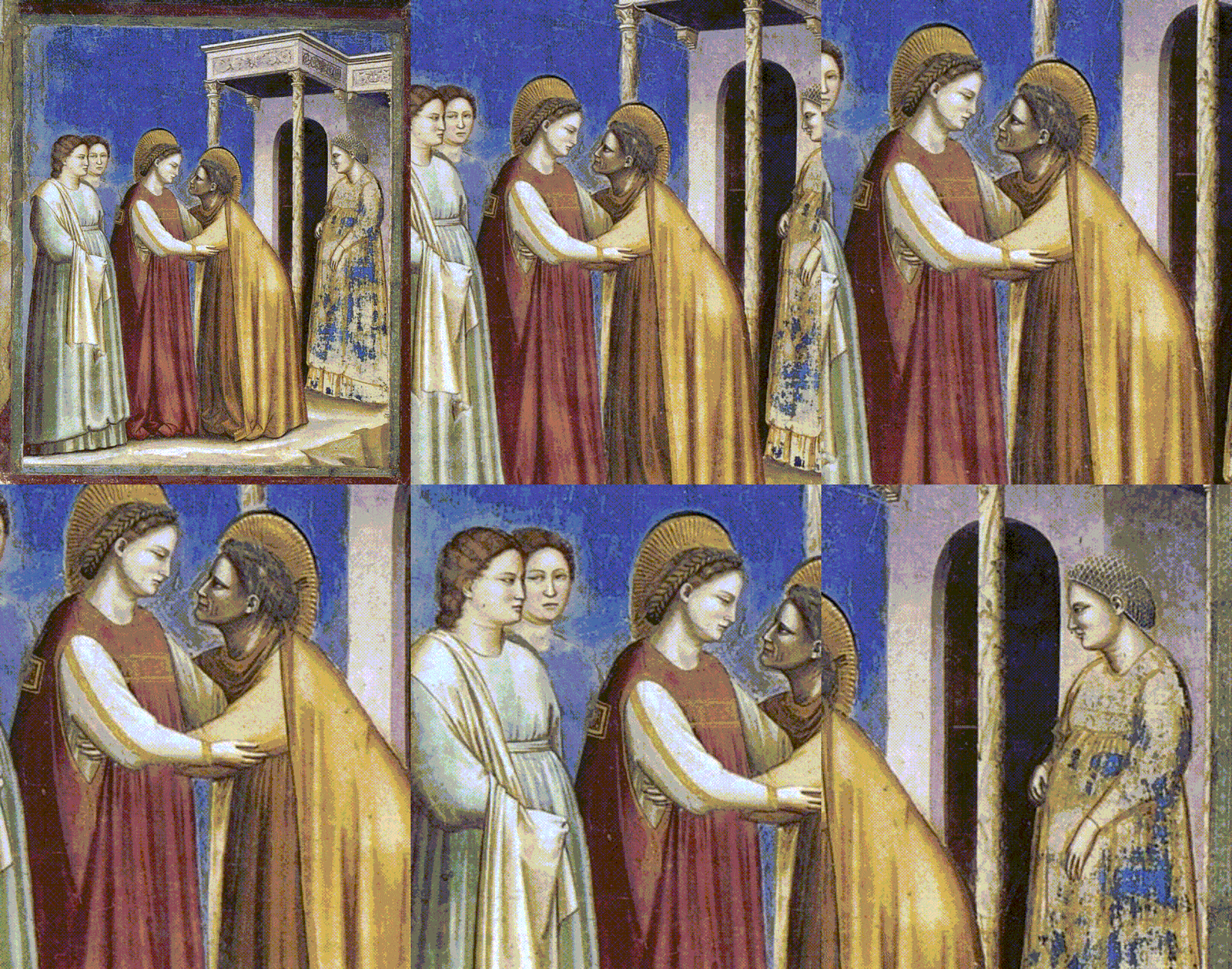
Giotto. «The Meeting of Mary and Elizabeth.» 1303–1305. Fresco. Scrovegni Chapel, Padua. The contrapposto and the contact of hands unite the characters despite the difference in their poses.
In «Maria and Elizaveta’s Meeting, ” the interaction is also built on the closeness of the figures and the reciprocal placement of their hands. However, the contour of the pair appears different: their reciprocal movements preserve the distinction between the two standing figures. Elizaveta’s lean and Maria’s posture do not create perfect mirroring, but rather a responsive movement with a difference in head height. The surrounding figures are placed to the sides of the encounter. Their presence expands the scene, but the direct exchange of gestures remains focused between the two women. The touch highlights the primary connection, while the surrounding characters establish its public context.
Comparing this to Joachim and Anna shows that the unity of figures can possess different degrees of compositional closure.
Giotto. «The Meeting of Joachim and Anna at the Golden Gates.» 1303–1305. Fresco. Scrovegni Chapel, Padua. The embrace of Joachim and Anna forms an intimate pair. This is contrasted by a more open group of accompanying figures.
In both scenes, touch reduces distance and highlights the pair within the group. Furthermore, the expressiveness depends on the reciprocal pose: the hand becomes part of the mutual movement. Comparing them allows us to identify three characteristics of compositional proximity—contact, reciprocal direction, and contour overlap. The combination of these elements makes closeness visible, but the specific meaning of the encounter is refined by the narrative. The next chapter examines relationships that can emerge even without direct contact.
III. Focus: How the Hand Connects Stage Space
A gesture has the ability to connect distant figures. An outstretched arm establishes a direction that the viewer relates to another character or event. This vector does not exist in isolation; it is supported by the turn of the head, the posture of the body, and reciprocal movements. In «The Resurrection of Lazarus» and «Entry into Jerusalem, ” we can compare how Christ’s gesture organizes a connection with the group while remaining a part of different spatial situations.
Giotto. «The Raising of Lazarus.» 1303–1305. Fresco. Scrovegni Chapel, Padua. Christ’s gesture is directed toward Lazarus and unifies the scattered parts of the composition.
In «The Raising of Lazarus,» Christ and Lazarus are situated in different parts of the scene. The raised and outstretched hand of Christ establishes the connection between them. The movement of the palm is supported by the turn of the head and torso, making it appear directed toward a specific character. Lazarus’s figure serves as the visual response to this direction. The surrounding figures react unevenly: some lean in, others stand, and some have their hands brought close to their faces. Thanks to these varied reactions, the event gains multiple points of resonance. Meanwhile, Christ’s composed gesture maintains clarity amidst the more fragmented movements. The viewer can read the composition through the relationship between the action and the responsive poses.
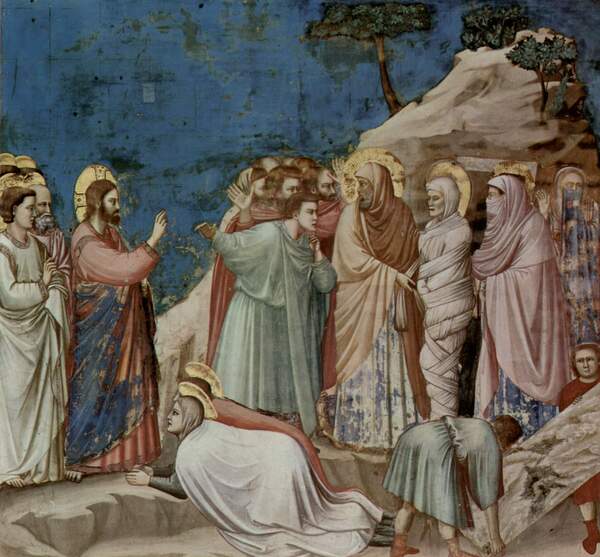
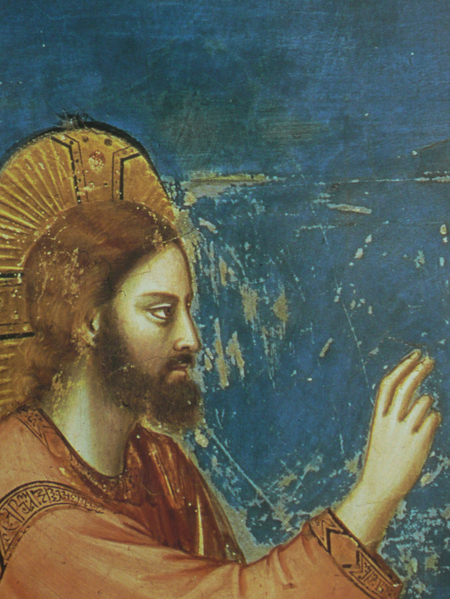
Giotto. «The Resurrection of Lazarus.» 1303–1305. Fresco. Cappella Scrovegni, Padua. Christ’s directed gesture and the figure of Lazarus amidst the surrounding participants. Fragments of a single fresco.
In «Entry into Jerusalem,» the hand of Christ is incorporated into the procession’s movement. The figure on the donkey faces the welcoming group; the gesture connects the progression from left to right with the actions of the people at the gates. Before Christ, characters are bowing and laying out their clothes, while figures among the tree branches are visible above. In contrast to the actions directed toward a single addressee in the scene of Lazarus, a distributed response emerges here. This reception is repeated on several levels: the hand of Christ, the bows of the welcoming figures, the movements with the clothes, and the branches. The direction organizes the transition between the two groups while preserving the distinctness of their actions.
Giotto. «Entry into Jerusalem.» 1303–1305. Fresco. Scrovegni Chapel, Padua. The procession’s movement meets the inclinations and gestures of the greeters.
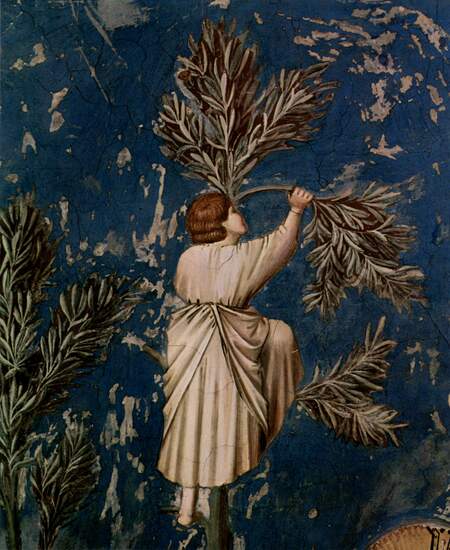
The comparison illustrates two ways of organizing space through gesture. In «The Resurrection of Lazarus,» the connection between two figures is highlighted, surrounded by the reactions of onlookers. In «Entrance to Jerusalem,» the response is distributed within the welcoming group. In both instances, the hand works in conjunction with the overall directionality of the body. Gesture becomes a means of connection across a distance: characters can belong to different parts of the composition while remaining participants in a single action.
IV. Distance: the gesture that defines a boundary
For the expressiveness of gesture, the possibility of contact is essential. An extended arm may meet a reciprocal movement, or it may remain in the space between figures. In such scenes, the unfilled space acquires meaning—it shows the limit of proximity or the gap between participants. «The Expulsion of Joachim from the Temple» and «Do Not Touch Me» allow us to compare two different situations of contact limitation. Their narrative meanings differ, but in both, distance becomes a visible part of the action.
Giotto. «The Expulsion of Joachim from the Temple.» 1303–1305. Fresco. Scrovegni Chapel, Padua. The gesture of the priest and the direction of Joachim’s movement make the boundary of the sacred space an integral part of the event.
In «Joachim’s Exile, ” the priest’s hand is turned toward the departing character. Its direction is linked to Joachim’s body turn, as he cradles an animal and ends up on the opposite side of the temple enclosure. This action is read through the combination of gesture, body movement, and the architectural boundary. The priest is situated inside the structure, while Joachim is positioned at its edge. Therefore, the distance between the characters simultaneously represents a rift between two spatial positions. A single palm would be insufficient to convey this meaning—the sense of restriction arises from the entire staging of the figures.
Giotto. «The Resurrection. Do Not Touch Me.» 1303–1305. Fresco. Cappella Scrovegni, Padua. The outstretched arms of Mary Magdalene and the movement of Christ create a connection that maintains the space.
In «Do Not Touch Me, ” Mary Magdalene kneels, reaching out her hands toward Christ. His figure moves to the right, but his head and the hand turned toward Mary maintain a connection with her. The orientation of the bodies does not align: Mary strives to close the distance, while Christ’s movement continues to separate them. A visible gap remains between their hands, allowing the scene to be perceived as a paused approach. Unlike the expulsion of Joakim, there is no temple enclosure separating the participants here—the boundary arises within the relationship between the figures themselves. The gesture supports the appeal to another person while simultaneously maintaining distance.
Giotto. «The Expulsion of Joachim from the Temple.» 1303–1305. Fresco. Scrovegni Chapel, Padua. The boundary in the positioning of hands and bodies: the removal of Joachim. Fragment of the scene.
In the first example, the gesture is incorporated into the removal of a character from a confined space; in the second, it accompanies an encounter where physical contact does not occur.