Concept
Soviet posters served both as a means of information and an instrument of state propaganda, through which societal values, ideals, and models of behavior were formed. Particular attention was given to youth—a generation in the process of developing its worldview.
Through visual imagery and slogans, the state sought to engage young people in public and political life and to shape the concept of what the ideal Soviet citizen should be. Youth were depicted as active, goal-oriented, and ready to participate in transforming society.
The positive image of the young person transformed depending on historical events and the state’s social goals. During the revolutionary period, youth were presented as participants in the political struggle and supporters of the new government; during industrialization and collectivization, they were active creators of a new society, workers, and builders; during the Great Patriotic War, they were defenders of the Motherland and heroes; in the post-war period, they were participants in rebuilding the country, educated specialists, and students; and in subsequent decades, they were athletes, scientists, engineers, and active members of public life.
This visual study is aimed at examining this transformation: it investigates how the external appearance, social roles, behavior, and values associated with the young generation changed, and which enduring traits remained in the image of the ideal Soviet person throughout the history of the USSR.
Hypothesis
The positive portrayal of Soviet youth in posters was not static: it transformed in alignment with historical events and current state objectives. Despite changes in external appearance, social roles, and methods of depicting young people, a core ideal remained constant—a proactive, ideological, disciplined, and socially conscious individual.
Navigator
1 A Revolutionary Generation 2 Builders of the Nation 3 Defenders of the Motherland 4 Generation of Knowledge 5 Physically Perfected Generation? 6 Youth and Society 7 The Human of the Future
A Revolutionary Generation
A wedge—a political metaphor for a revolutionary advance
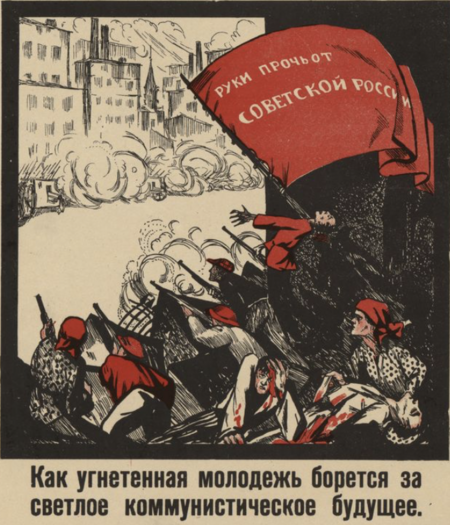
The fight for the future
In revolutionary posters, youth is portrayed as a mass force supporting the new regime and participating in societal transformation. Numerous depictions of young people underscore the unity of a generation and the scale of the social movement. Compositions are often built upon dynamic diagonals, wedges, and circles. For example, the red wedge symbolizes the advance of revolutionary forces and the dismantling of the old order, while the circle can denote the former world undergoing transformation. In some posters, young people literally walk over the fallen symbols of the former authority, demonstrating its loss of influence.
Color contrast: the abundance of red is associated with the revolution, the new government, and the idea of struggle, whereas black is used to represent the old order and its supporters. This is not a literal depiction of the historical conflict between the Red and White Armies; here, black functions more as a graphic signifier of an antagonistic, obsolete past. Slogans and direct calls address young people, urging them to join the ranks of the revolutionary movement and participate in building a new society.
The image of factories and smokestacks is also intentional: industry serves as a symbol of the proletariat—the social force upon which the revolution depended—as well as the future industrial transformation of the country. Thus, the young person is depicted as an active participant in the struggle for a new social structure.
From Revolution to Creation
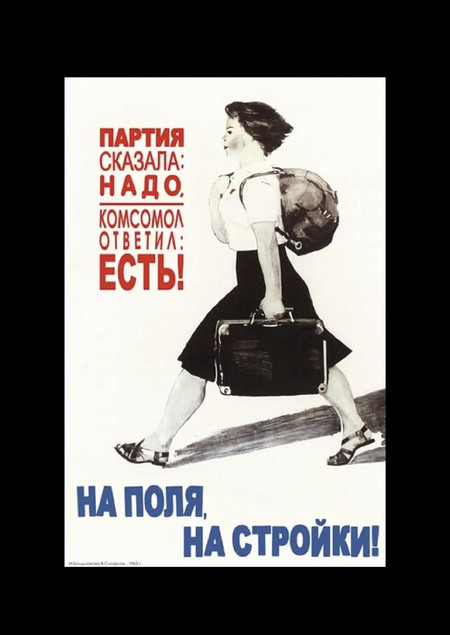
In the 1920s, the young man receives a call to join the transformation of society, while from the 1930s to the 1970s, he receives increasingly specific tasks.
Transitioning from political calls to labor demands
Defender of the Homeland
Now, the youth must defend what has been created—the Motherland, the people, and the achievements of previous generations.
The wedge form recedes, and the human figure takes center stage.
«in the front rows.» Young people are given a special role to lead and serve as an example for others.
During the Great Patriotic War, the image of Soviet youth took on a heroic character. The young person was depicted as brave, resolute, and ready to defend the Motherland. Propaganda appeals became more specific and insistent: the youth were called to volunteer on the front lines, master military skills, display heroism, and stand at the forefront of the struggle. At the same time, traits we had seen before were retained: collectivism, activity, idealism, and a readiness to prioritize societal interests over personal ones.
Youth Rebuilding the Country