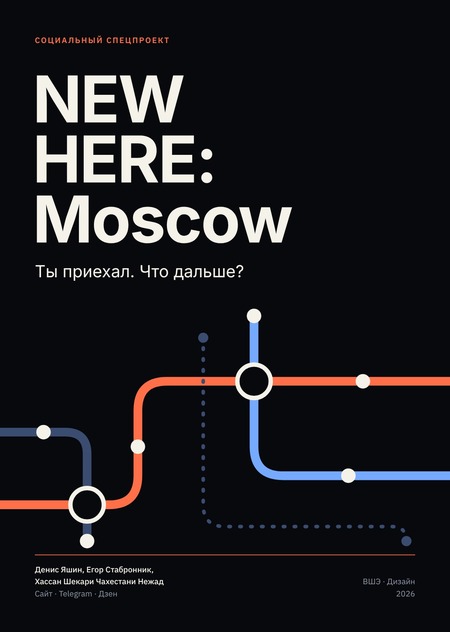
NEW HERE: Moscow — an interactive special project for international students who have just arrived in Moscow. It transforms the initial 30 days from a chaotic series of tasks into a clear roadmap, showing that the challenges of the first weeks are common, not personal.
Problem: steps exist, but their order is not visible
Everything is officially outlined. HSE advises completing all mandatory procedures within the first 30 days; there are three working days to register for migration purposes. However, the steps are interdependent: access to the university buildings is only granted after submitting copies of migration documents. The route differs for students from visa and non-visa countries, and the regulations are currently changing. We observed this within the team. Hassan arrived from Iran on a study visa, and Egor from Kazakhstan without a visa, and their procedures diverge right at the migration registration stage.
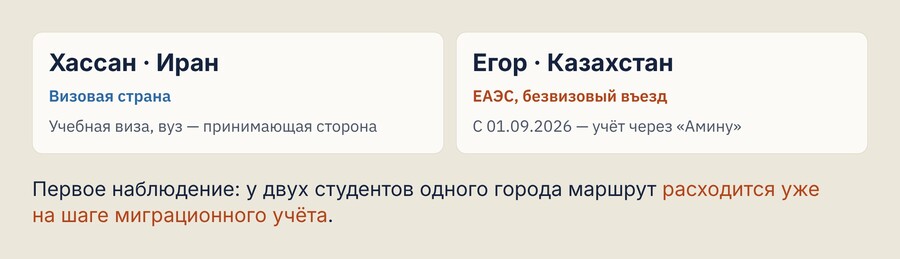
Two pathways within the team
The number of international students in Russia is growing, and record-keeping is moving into applications. Memos cannot keep pace with the regulations, so every step requires a source and a date.
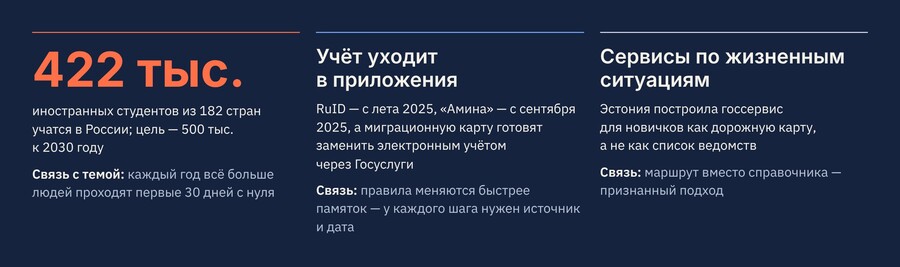
trends relevant to the project
Studio
An international student, aged 18–30, arriving in Moscow during the first few weeks. Having a smartphone and using search engines isn’t the issue; the problem is not knowing what question to ask. They trust fellow countrymen and chats more quickly than official websites, even when the advice is outdated. The main fear is missing a deadline, and the biggest misconception is, «Everyone else figured it out—the problem is me.»
Communication Objective
We are creating an interactive 30-day map for international students newly arrived in Moscow, so they can see their next steps and understand that their struggles are common, not personal.
Right now, the student might think the chaos of the first few weeks is due to their own inability to keep up. After the project, we want them to see: the steps are scattered across systems that don’t explain their sequence, and almost everyone gets stuck.
From «I can’t handle this» to «The system doesn’t explain itself»
What We Did
Four-page web special project. Start—a scroll story of seven scenes where the route line is drawn as the reader scrolls. My Route—five questions: country, entry, date, university, housing. Map—eight steps with filters for time and examples for both visa and visa-exempt students. Step—each step is a short narrative. Every step card contains the same elements: what to do, why, where, and what it unlocks.
Four pages—four roles
The visitor journey—from a chaos of tasks to a defined route.
Completing the episode is the «Hall Pass» step. The student clicks «Hall Pass,» sees that immigration documents are required first, and learns that others get stuck here too.
sees → does → receives an answer → discovers
Web and mobile versions
Why is it like this
Analogues include Integreat in Germany, Handbook Germany, Settling in Estonia, university guides, and student chats. Each one covers its own segment, but no one shows the seams between them. That’s why it’s a map, not a list: dependencies are only visible in the connections. The project has two values: a practical one—the next step and source—and a social one—"this isn’t just about me.» There is no fictional character. The protagonist is the visitor on their second day in Moscow, and every action they take reveals a new idea.
Visitor history and actions
The visual is assembled from a nocturnal, unfamiliar city and a subway map—the most intuitive way for a visitor to understand the system. The dark background represents a state of «not understanding,» while the glowing line signifies the arrival of comprehension. Blue represents the main pathway, and orange highlights what is important right now. The typefaces used are Inter and IBM Plex Sans.
palette, typography, and TOV
moodboard — night, subway map, and route lighting
The line grows alongside understanding.
Promotion
All roads lead to the website. Online channels include Telegram and Zen. Offline materials feature the weekly «First 30 Days» newsletter by Egor Stabronnik—which could be included in the university’s welcome kit—and poster concepts by Hassan for dormitories and campuses. We did not launch paid advertising: the budget was zero rubles, and without a website counter, there was no way to track clicks.
Project ecosystem