The first museum in Novgorod was established in 1865; it was originally called the «Novgorod Museum of Antiquities under the Governor’s Statistical Committee.» Its opening coincided with the celebration of the 1,000th anniversary of Rus'. Mikhail Izmailovich Bogoslovsky—a spiritual writer, clergyman, archaeologist, and member of the Imperial Society for the Encouragement of the Arts—was the initiator of the museum’s creation.

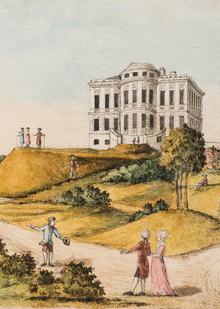
On May 16, 1890, the museum, located in the Petrovsky cottage on Pochayna Street, was named the «Petrovsky Historical Museum.» Its development took more than four years.
While the museum exhibit included some icons, the organizers were more interested in domestic culture and collected furniture, costumes, and household items. In 1913, the Novgorod Diocesan Archive was established, which held a collection of 350 icons dating from the 14th to 19th centuries.

Museum Exhibition. 1893
After the revolution, the number of museums in Novgorod increased, and by 1929, at the time of unification, there were five. Before the Great Patriotic War, all the architectural, historical, and artistic monuments of the city were transferred to the Novgorod Museum. By this time, the museum’s collections already numbered 4,678 exhibits. In August 1941, part of the collection was evacuated, but during the occupation, most of the icons were lost. Many exhibits were permanently lost, and only some were found and returned to Russia.

In 1959, the Novgorod Museum was reorganized into the Republican State Museum-Reserve of History, Architecture, and Art. In 1976, following the consolidation of all major regional museums, the Novgorod State United Museum-Reserve was established. The undeniable value of the Novgorod Reserve lies in its masterpieces of Old Russian architecture and its rich collection of icons—a collection comparable only to those of the Tretyakov Gallery and the Russian Museum.
Fragment of the iconostasis in the Church of Peter and Paul in Kozhevniky
The exhibition of icon painting from the 11th–17th centuries is housed in the Presence Building within the Novgorod Kremlin grounds. In addition to works from the Novgorod school, the museum’s collection features icons by Pskov, Moscow, and Yaroslavl masters. The collections also hold examples of icon painting from the 18th to early 20th centuries. In May 2004, these pieces formed an entire section of the museum’s new exhibition.
Icons of prophetic and local officials. The prophets Jeremiah and Jonah. Mid-16th century.
Among the museum’s masterpieces are icons of the prophetic rank from the Peter and Paul Church in Kozhevniks, built in 1406. They date from the mid-16th century. At one time, they were part of a high—from floor to vault—iconostasis. The row of prophetic icons depicted preachers and prophets—authors of scripture in which Christian interpreters saw prophecies concerning the Mother of God and the coming of Christ.
Icons of Prophetic and Local Officials. Prophets Jacob and Zechariah. Mid-16th Century.
Some of the prophets—David, Daniel, and Solomon—have traditionally been viewed as Old Testament prototypes of Jesus. The liturgical rite of the Church of Peter and Paul consisted of seven sections: the central section featured the icon of the Theotokos «Sign» with Christ Emmanuel, while the six side sections displayed waist-length images of the prophets, arranged in pairs. Stylistically, this rite draws from similar models of the Moscow school from the late 15th–16th centuries, yet it distinguishes itself through the profound expressiveness of its execution. Several of the prophets were painted directly from the influence of icons created by Andrei Rublev. The smooth yet resilient contours of the figures generate a volumetric substance that does not disrupt the visual plane.
Icons of prophetic and local officials. Prophets Zephaniah and Ezekiel. Mid-16th century.
Dark figures contrast with deep golden backgrounds, upon which individual landscape fragments are placed, reminiscent of Rublev’s «Trinity.» Both the background and the figures are painted in several layers. While the iconographer, in rendering the figures, moved from dark patches to light spaces, the background treatment proceeded in the opposite direction—from light to dark. This resulted in a convergence of the original color contrasts. Such a consistent and deeply considered working process was rare in the sixteenth century, a period when many iconographers aimed to «lighten» their painting and developed Dionysius’s decorative improvisations.
Icons of prophetic and local officials. Prophets Moses and David. Mid-16th century.
The Novgorod United Museum-Reserve is one of the oldest in Russia. Its collection holds over 650,000 archival units, including more than 350,000 items from the main collection. The museum complex manages a total of 36 exhibitions and permanent displays, overseeing 170 buildings, 95 of which are architectural monuments from the 12th through the 19th centuries.
Icons of Prophetic and Local Officials. Prophets Hosea and Habakkuk. Mid-16th Century.