Award Medal for First Place Gilded Silver Height: 61.3 mm Width: 57.3 mm Thickness: 5 mm Weight: 185 g


Award Medal for Second Place Silver Height: 61.3 mm Width: 57.3 mm Thickness: 5 mm Weight: 181 g


Award Medal for 3rd Place Bronze Height: 61.3 mm Width: 57.3 mm Thickness: 5 mm Weight: 147 g
Design: Yagi Kazumi, Ikko Tanaka (both — Japan)
Reverse: A snowy slope crosses a wavy, voluminous trail, symbolizing a bobsled track. To the right, the outline of a stadium with ice tracks for figure skating. The rectangular medal ribbon features an icon representing the Olympic discipline.
Obverse: The center features the official emblem of the Sapporo Games. Above the emblem, there is text in Japanese: «XI Winter Olympic Games.» On the bottom left, it is duplicated in English: XI OLYMPIC WINTER GAMES SAPPORO ’72 — mentioning the city and the year of the Games. The ribbon features the name of the sport in English on a single line.
SECOND «GOLDEN» BREATH
Cross-Country Skiing: 5 km, 10 km, 3×5 km relay
Galina Kulakova
In Sapporo, Kulakova was considered a veteran—the athlete was nearly 30 years old. Moreover, she fell ill before the Olympic Games, which seemed to increase her rivals' chances. Everyone had forgotten that before the 1970 World Championships, Galina underwent complex surgery. Doctors had stated that the skier was unlikely to return to elite sports, but Kulakova returned with such vigor that she immediately won the five-kilometer world championship race. So, for her first 10-kilometer race, Galina forgot about all her ailments, immediately surged ahead, and overtook her teammate, Olya Olyunina, who was in second place, by 36.3 seconds. The suspense arose in the second race, which was Kulakova’s signature event—the five-kilometer race. Finn Marietta Kaiosmaa took an early lead right from the start, holding a gap of about fifty meters at the three-kilometer mark. However, on the final ascent, Kulakova found a second wind, and on the finish line, to the cheers of the spectators, she not only caught up with her rival but also passed her by three seconds!
There were no competitors capable of challenging Kulakova on the inclines. However, on the flatter sections of the course, the Soviet athlete was troubled by back pain.
Sometimes a cowherd and milker, sometimes a ski instructor
Kulakova’s childhood was difficult. She was born in Udmurtia into a large peasant family, the last—ninth (!) child. In reality, she was the eleventh—two had passed away. She never saw her father; he died in the autumn of 1941. She took up skiing in the fifth grade—solely for commuting to school. In the later years of school, she worked at a state farm: caring for livestock and working as a milkmaid. It wasn’t until she entered the pedagogical school that she began participating in the ski section. For a long time, her results were mediocre, but once at a factory competition, she substituted for her sick sister, Lida, and took second place. This was in 1964—two years later, 25-year-old Kulakova was already joining the Union national team…
Galina Kulakova at the table with family members
Harmful ephedrine
Just before the first race in Innsbruck in 1976, Galina caught a cold and decided to put in nasal decongestant without informing the doctor. She finished in third place and, as a medalist, went to the doping test. To her horror, the analysis showed the presence of the prohibited ephedrine in her body. Galina faced disqualification, but, «being understanding, ” the IOC officials only took away her medal. „I was running sick!“ Kulakova recalled. „My tongue was stuck to the roof of my mouth so I couldn’t spit, and I was accused of doping and had my medal taken away. How much I cried then!“
Ointment in exchange for vodka
The team featured elite Soviet athletes, but certain positions remained scarce. «We had excellent Finnish skis, ” recalled Kulakova. „We just had to buy ointment abroad. To find the money for it, we would take two bottles of vodka with us—that was the limit allowed to be taken out of the Soviet Union. We traded them for ointment.“
Galina Kulakova (born April 29, 1942). Soviet skier. Four-time Olympic champion (1972 — 3, 1976), two-time silver medalist (1968, 1980), two-time bronze medalist (1968, 1976) at the Olympic Games. Five-time World Champion (1970 — 2, 1974 — 3). Thirty-nine-time USSR Champion.
THROUGH THE SNOWFALL TO VICTORY
Speed Skating: 1500 m, 5000 m, and 10,000 m
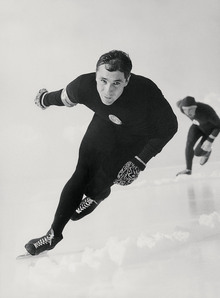
Ard Schenk
At the 1972 Winter Games, 27-year-old Dutch speed skater Ard Schenk had already set 15 world records and was hoping to repeat the achievement of Soviet athlete Lidia Skoblikova, who won all four distances in Innsbruck in 1964. The program began with a 5,000-meter race. Initially, things were not going well for Ard—by chance, he started in the first heat against a weak competitor, Italian Giancarlo Glodero. Furthermore, heavy snow suddenly fell, forcing him to abandon the pursuit of records. Schenk, naturally, overtook the Italian by more than half a minute, but the result was ordinary–7:23.61 minutes (his own world record was 7:09.8). It seemed that Schenk might not even make it into the medal standings, as the weather favored his competitors: the snowfall stopped, and the sun came out. However, after the last heat finished, it turned out that no one managed to surpass the outstanding skater that day. He was ahead of everyone else, not just metaphorically (Schenk’s height was slightly under two meters). The «silver» time—set by Norwegian Roar Grønwol—was 7:28.18, and the «bronze» time—by another Norwegian, Stan Stensnes—was 7:33.39.
In the Netherlands, they were so impressed by the success of their compatriot that they named a flower in his honor—Crocus chrysanthus Ard Schenk.
A fall that entered world sports history
A Dutchman’s dream of four gold medals in Sapporo crumbled after the 500-meter race. Immediately after the start, Schenk stumbled and fell onto the ice. Any other speed skater, falling on such a short distance, would have been doomed to last place, but Ard got up and rushed forward so swiftly that he finished 34th with a time of 43.40 seconds. «Everyone took it as a kind of world record, because no one has ever run the 500 meters with a fall like that, and probably never will…» wrote an astonished reporter.
His fall from the 500-meter tower only increased the popularity of the tall, blue-eyed Dutchman.
The farmer by compulsion
In 1962, when Schenk won the national junior championship gold medal in both the 500-meter race and the marathon, the newspapers began writing about him as a rising star. His father was unhappy with the sudden fame: «All these are cheap compliments! The first success says nothing. He needs to work!» And with those words, he sent the young man… to the farm. «The assignment had a sobering effect and set me up for the most serious mindset, ” Schenk recalled later. „Besides, working on the farm—chopping wood, mowing, caring for animals—became an excellent form of general physical training!“ The relevance of such an unconventional approach was proven by his athletic results.